ARX Software Development Manual: Data Consistency Management
Overview
-
ARX does not provide abstraction for hardware caches, so software-level consistency management is required in certain cases.
-
With a default caching policy, data consistency management is not required.
-
To enhance performance, users must explicitly assign variables to cacheable regions and manage their consistency manually.
Prerequisites
-
Users should understand caching mechanisms and cache architectures from a computer architecture perspective.
-
It is necessary to understand how C code is executed at the hardware level.
-
If not well understood, it is advisable to rely on the default caching policy without attempting manual performance optimization.
Caching Policy
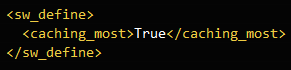
Caching policy defined in #(platform xml).
-
The caching policy can be defined in the
#(platform xml)file (refer to the figure below). -
CACHING_NONE
- The CPU does not cache any data.
-
CACHING_SAFE
- The CPU caches only data that does not require software-level consistency management.
-
CACHING_MOST
-
The CPU aggressively caches most data to enhance performance.
-
It is the user’s responsibility to manage data consistency in software.
-
-
Note: The caching region varies depending on the policy.
CACHING_NONE CACHING_SAFE CACHING_MOST Start - Variable 0x00000000Last - Variable 0xBFFFFFFF
Cacheability of Variables
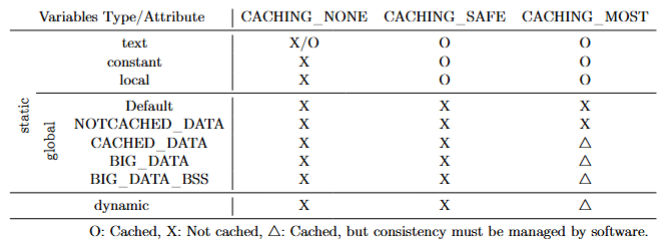
-
the figure below is the most accurate.
-
Static variables
-
This does not refer to variables declared with the static keyword.
-
Generally, these variables do not require consistency management, regardless of the caching policy.
-
If global variables are cached for performance optimization, appropriate attributes must be set (see Data Consistency Management).
-
If hardware IP reads a local variable via a pointer, consistency management becomes necessary—but such usage typically reflects poor coding practice.
-
-
Dynamic variables (allocated by
malloc)-
Under the CACHING_NONE and CACHING_SAFE policies, consistency management is not required.
-
If the CACHING_MOST policy is used, consistency management is required for dynamically allocated variables.
-
-
Consistency Management
-
Include the header file
core_dependent.h. -
Insert
flush_cache()at your discretion.
-